
Visual Arts/Learning & Discovery Program: Discovering Vincent van Gogh
Duration
30–60 minutes
Preparation Time
10–15 minutes (Display the presentation featuring the three selected Van Gogh paintings, print the three corresponding art templates, and set out the paint, brushes, and other art materials).
Best For
Participants who enjoy art, learning, conversation, visual exploration, and hands-on creative activities. The program can be adapted for different levels of verbal, cognitive, and physical engagement.
Goals
Participants will:
Discover the life and artwork of Vincent van Gogh through visual exploration, storytelling, and conversation.
Learn about Van Gogh's distinctive use of colour, movement, lines, and expressive brushstrokes.
Foster social connection by sharing observations, interpretations, and creative ideas with others.
Experience opportunities for personal expression and creativity through a hands-on visual arts activity.
Description
Discover the life and art of Vincent van Gogh, one of the world's most recognizable artists. Through photographs, stories, visual exploration, and conversation, participants will learn about Van Gogh's life and explore some of his most famous paintings. Participants will be encouraged to look closely at Van Gogh's use of colour, movement, lines, and expressive brushstrokes. The program concludes with a
hands-on visual arts activity where participants create their own artwork inspired by Van Gogh's distinctive style.
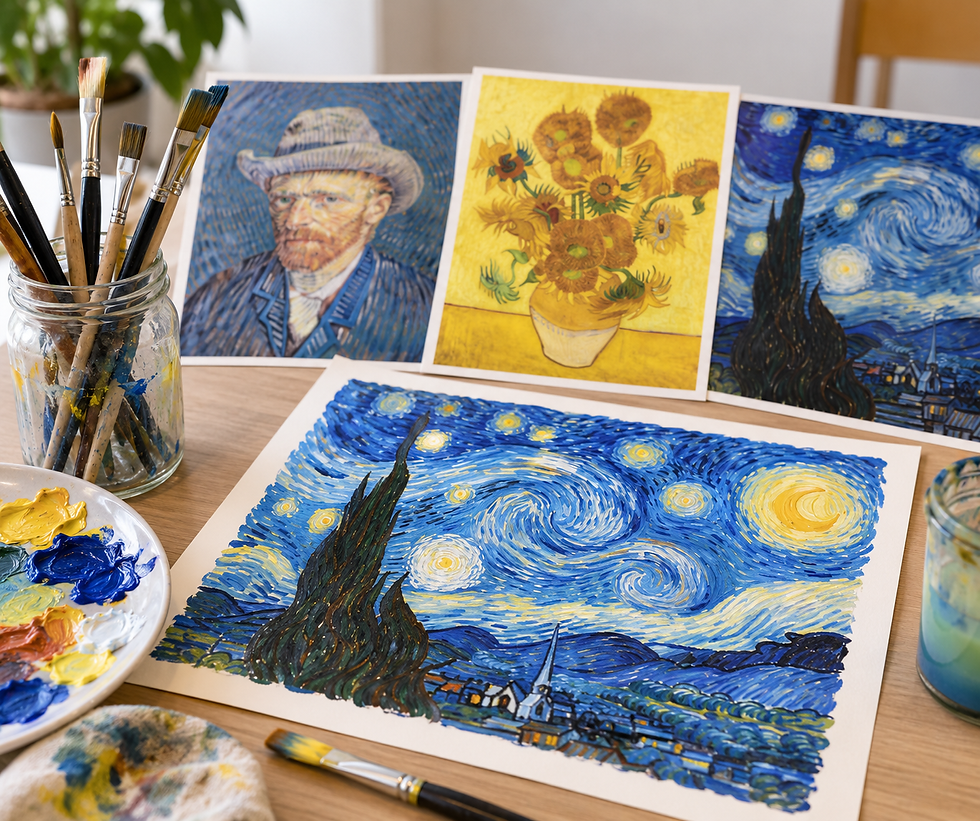
Materials
Screen to display slideshow
Slideshow
Pre-printed Van Gogh-inspired templates (print enough so participants can choose)
Washable paint
Paintbrushes in a variety of sizes
Paint palettes or paper plates
Water containers
Scrap paper for practising brushstrokes
Table coverings
Instructions and script (also provided below)
Flow
Welcome & Introduction (3–5 mins)
Discovering Van Gogh (10–15 mins)
Van Gogh Painting (20 –30 mins)
Sharing & Closing (5–10 mins)
Adaptations & Facilitator Tips
Encourage participants to point to something in the painting if they do not want to answer verbally.
Emphasize that the goal is to experiment with Van Gogh's style, not to make an exact copy.
Provide larger brushes or adapted materials as needed.
Participants who do not want to paint can participate by choosing colours, observing, or helping someone else.

Instructions & Script
Welcome & Introduction 3–5 minutes
"Welcome everyone! Today we're going to explore the life and art of Vincent van Gogh. Van Gogh is one of the most recognizable artists in the world. Even if you don't know much about him, chances are you've seen one of his paintings before. We're going to look at three of his paintings today and learn a little bit about the artist behind them. As we look at each painting, I'll tell you a little bit about Van Gogh and the story behind the artwork. Then we'll look closely at the painting together and see what we notice. At the end, you'll have the opportunity to choose one of the paintings and create your own artwork inspired by Van Gogh."
Optional Reflection Prompts:
"What do you think of when you hear the name Vincent van Gogh?”
“Have you ever seen a painting by Van Gogh?”
"Whether you've heard of Van Gogh before or this is your first time learning about him, we're going to get to know the artist behind some very famous paintings. Let's start with a little bit about his life."
Discovering Van Gogh (10 - 15 mins)
Turn to Slide 1
Painting 1: Self-Portrait with Grey Felt Hat
"Vincent van Gogh was a Dutch artist who lived in the 1800s. Although he wasn't widely recognized as a successful artist during his lifetime, his paintings would eventually become some of the most famous and recognizable artworks in the world. This painting is a self-portrait that Van Gogh painted of himself. He created many self-portraits throughout his life. They gave him an opportunity to experiment with colour and different ways of using his brush. Take a moment to look closely at this painting. What do you notice first?"
Provide space for participants to respond.
Optional Follow-Up Prompts (use these if the group needs more support in discussion):
"What colours do you notice?"
"What do you notice about his face?"
"Can you see the individual brushstrokes?"
"Do the brushstrokes all go in the same direction?"
"When we look closely, we can see that Van Gogh didn't try to hide the marks made by his brush. The individual strokes are actually part of what gives the painting its character. Van Gogh experimented with colour throughout his career, and colour became one of the things he was especially known for. Let's look at another painting where colour really takes centre stage."
Turn to Slide 2
Painting 2: Sunflowers
"This is one of Van Gogh's most famous paintings. He was fascinated by sunflowers and painted them several times, using them to explore colour, light, and texture."
Optional Reflective Prompts:
“What colour do you notice first?”
“How many different shades of yellow can you see?”
“What other colours can you find?”
“Are all of the flowers the same?”
"In this painting we can see Van Gogh's brushstrokes throughout the painting. He used short, thick strokes to build up the petals, centres, leaves, and stems. The strokes move in different directions, helping to give the flowers shape and texture. In our final painting, we're going to see how he used his brushstrokes to create movement."
Turn to Slide 3
Painting 3: The Starry Night
“This is probably Van Gogh’s most famous painting — The Starry Night. Van Gogh painted it in 1889 while staying at an institution in the south of France. He based the painting on the view from his window, but he also used his imagination to transform the landscape. Look closely at the sky. Instead of painting it smoothly, Van Gogh used curved and swirling brushstrokes. These lines make the sky feel full of movement.”
Reflective Prompts:
“What do you notice first?”
“Does the sky look calm or full of movement?”
“What do the swirling lines make you think of?”
"We've now seen three important parts of Van Gogh's style: colour, visible brushstrokes, and movement. Now we're going to try one of these techniques ourselves!"
Van Gogh Painting (20 - 30 mins)
Step 1: Introduce the Technique
Give each participant a paintbrush, paint, and a piece of scrap paper.
"One of the things that makes Van Gogh's paintings so recognizable is his brushwork."
"Rather than always blending his paint until it is completely smooth, he often left his brushstrokes visible. Let's try it ourselves."
Step 2: Demonstrate Different Brushstrokes
"Let's making a few different kinds of brushstrokes on our paper."
Demonstrate on your own paper the following for the group:
Short strokes
Long strokes
Curved strokes
Swirling strokes
Facilitator Tip: Walk around and support participants in trying these different brushstrokes.
Step 3: Choose Your Painting
Distribute the three templates and invite participants to choose one.
"Now it's time to create your own Van Gogh-inspired artwork. We've prepared three templates based on the paintings we explored today. You can choose whichever one interests you most."
Step 4: Create Your Artwork
"Use the brushstroke technique we just practised to fill in your painting. Think about the direction of your brushstrokes. You can make them short, long, curved, or swirling. You don't need to copy Van Gogh's painting exactly. The template gives you the basic shapes, and you can decide how you want to use colour and brushstrokes to make it your own."
Allow participants to work at their own pace and provide assistance as needed.
Sharing & Closing (5–10 minutes)
When participants have finished, invite everyone to look at the artwork together.
Reflective Prompts:
"What is your favourite part of your painting?"
"What colours were you most drawn to? Why did you choose these colours?"
“What do you notice about the lines or shapes?”
Facilitator Tip: If discussion is limited, you can make observations about the artwork to encourage participants to notice different elements:
“I notice lots of bright colours in this painting.”
“I can see lots of short brushstrokes here.”
“These curved lines really make the painting feel like it is moving.”
“I notice that you used colours that are different from Van Gogh’s original.”
“There are lots of different shades of the same colour here.”
Facilitator Closing: "Today we discovered some of the things that made Vincent van Gogh's artwork so distinctive. We explored his use of colour, movement, lines, and visible brushstrokes, and then we tried one of his techniques ourselves. We all started with the same three paintings, but each of you made different creative choices. Thank you for exploring Vincent van Gogh and creating with me today!"


